
You don’t need a four year degree or a fancy title to earn well. You need a skill people pay real money for, and most of the ones that pay best can be learned from your couch. That’s the whole idea behind a high income skill: something in demand, something that pays, and something you can pick up online at your own pace.
Below are eight of them, with honest pay figures and a simple way to start each one. Salary numbers come from public data (Glassdoor, late 2025) and freelance ranges from Upwork, so treat them as ballparks, not promises. Your city, your experience, and your effort move the number a lot.
What counts as a high income skill
A few things have to line up. The skill has to be in demand, so there’s steady work. It has to pay above average, ideally well into five figures or more. And you have to be able to learn it online and do it remotely, so you’re not tied to one employer or one town. Every skill on this list checks those boxes.
The 8 high income skills worth your time
1. Data analysis and data science
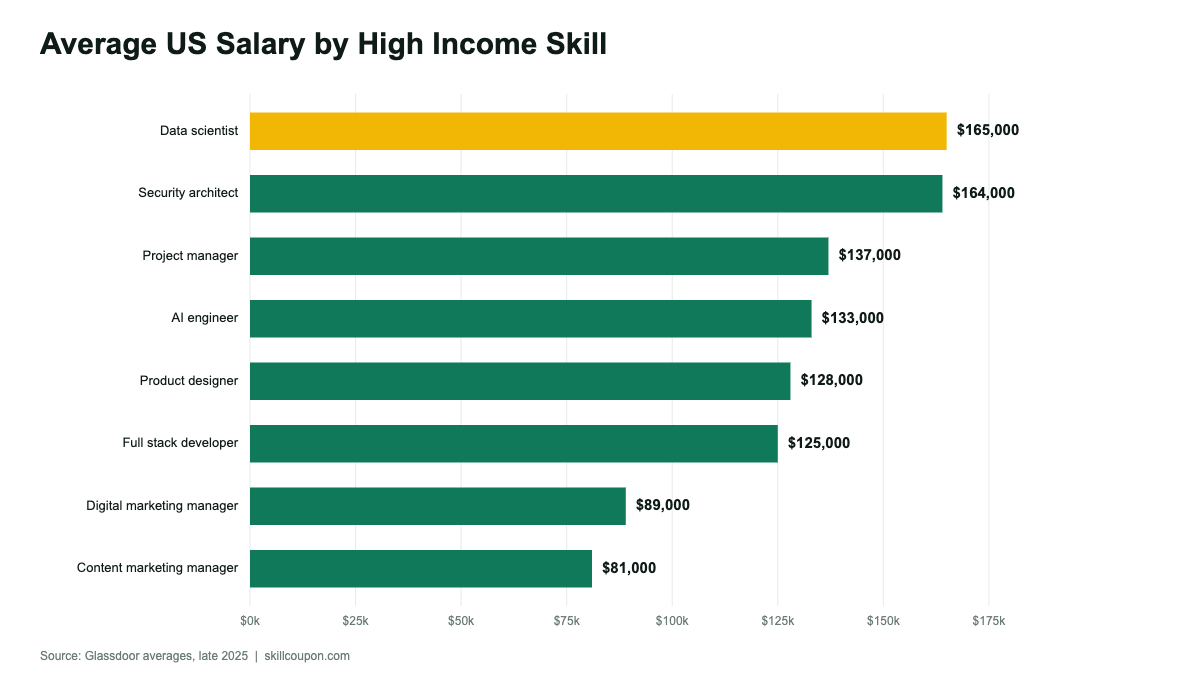
Companies are drowning in data and short on people who can make sense of it. A data analyst averages around $111,000 a year, and a data scientist sits near $165,000. On the freelance side, data work runs anywhere from $35 to $250 an hour depending on how deep you go. Start with spreadsheets and SQL, then add Python and a tool like Tableau.
2. AI and machine learning
This is the fastest moving lane right now. An AI engineer averages about $133,000, and freelance machine learning specialists can charge $50 to $200 an hour. You don’t have to build models from scratch to earn here. Plenty of people make good money just knowing how to put AI tools to work for a business. Our guide to making money with AI is a good first stop.
3. Software and web development
Building websites and apps is still one of the most reliable ways to earn online. A full stack developer averages around $125,000, and a front end developer about $103,000. New freelancers often start at $15 to $50 an hour and climb fast once they have a few projects to show. You can learn the basics free before you ever pay for a course.
4. UX and product design
Good design is the difference between an app people love and one they delete. UX designers average about $126,000 and product designers around $128,000. If you have an eye for how things should look and feel, this one pairs creativity with strong pay. A portfolio matters far more than a diploma here.

5. Digital marketing and SEO
Every business wants more customers, which keeps marketers busy. A digital marketing manager averages near $89,000, and freelance marketers charge roughly $15 to $45 an hour to start. Search engine optimization is one of the cheapest skills to learn and one of the most useful, since it also drives free traffic to your own projects. See our free SEO starter guide.
6. Cybersecurity
As more of life moves online, protecting it pays. An information security analyst averages about $111,000, and a security architect can clear $164,000. This one rewards steady study and a couple of certifications, and demand keeps climbing every time a breach makes the news.
7. Content creation and copywriting
Words and video still sell. A content marketing manager averages around $81,000, while social media managers start lower, near $56,000. The upside is how easy it is to begin. You can build a portfolio with a blog, a channel, or a handful of sample pieces, then trade up to paying clients.
8. Project and product management
Someone has to keep projects on track, and companies pay well for it. Project managers average about $137,000 and program managers around $124,000. If you’re organized and good with people, this skill leans on judgment more than code, and a single certification can open the door.

How to actually learn one of these
Pick one. Trying to learn all eight at once is the fastest way to quit. Start with free material to make sure you enjoy the work, then put money into one solid course to go deeper without paying full price. We keep a running list of discounted course deals for exactly that. After that, build one small real project, put it somewhere clients or employers can see it, and land your first paid gig. Momentum takes care of the rest.

Key takeaways
- A high income skill is in demand, pays above average, and can be learned online.
- Data, AI, and development sit at the top for pay, while design, marketing, and content are easier places to start.
- Learn free first, then buy one course at a discount instead of paying full price.
- A small portfolio beats a certificate for most of these skills.
- Pick one skill and go deep before you branch out.
Frequently asked questions
Which high income skill is easiest to start?
Digital marketing, SEO, and content creation have the lowest barrier. You can practice all three with free tools and your own website before anyone pays you a cent.
Do you need a degree for these jobs?
For most of them, no. Employers and clients care more about what you can show them. A strong portfolio or a couple of finished projects usually carries more weight than a diploma.
How long until a skill pays?
It varies. Some people land small freelance work within a few months of focused practice, while roles like data science or cybersecurity take longer to build. Consistency beats speed every time.
SkillCoupon shares this information for educational purposes only and does not guarantee any income or job outcome. Pay figures are averages from public sources and change over time. Some links on this site are affiliate links, which may earn us a commission at no extra cost to you.